
Claude Code
💻 Coding & DevAnthropic's agentic coding tool for the terminal.
Deep, agentic multi-file coding …Understands large codebases well
Terminal-based — learning curve …Usage-based cost can add up

AI assistant that knows your whole codebase.
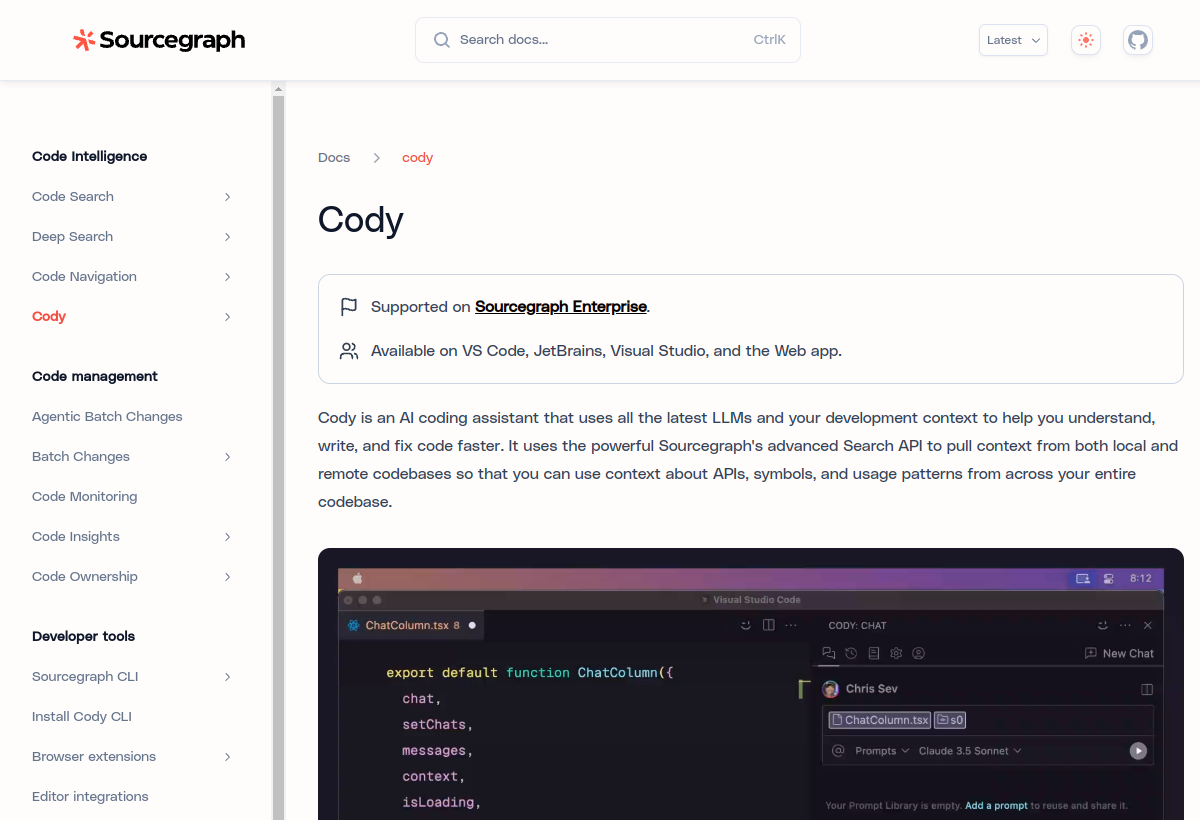
Cody by Sourcegraph provides AI chat and autocomplete with deep context from your entire repository, strong for large codebases.
Sourcegraph Cody sits in the Coding & Dev category and earns an overall AIProsNCons Trust Score of 7.9/10, making it a solid, dependable choice for most people.
Where Sourcegraph Cody shines: deep whole-codebase context, works across editors, and good for large repos.
No tool is perfect. The main limitations to weigh up are that best value needs paid/enterprise, setup for big orgs, and autocomplete less flashy than rivals.
Sourcegraph Cody runs on a freemium model: there's a free tier to try it, and paid plans (Free / $9+ mo) unlock the full feature set.
Sourcegraph Cody is worth it if you work in a large codebase and want context-aware AI. You should skip it if you want a minimal, plug-and-play tool.
Common user sentiment alongside our own hands-on take.
Synthesized from patterns in public user feedback, not a single verbatim quote.
“Users frequently mention works across editors.”
“A recurring theme in feedback is that best value needs paid/enterprise.”
“Deep whole-codebase context. Works across editors.”
“Worth it if you work in a large codebase and want context-aware AI. Just know that best value needs paid/enterprise.”
The closest coding & dev tools worth comparing.
If Sourcegraph Cody isn't quite the right fit, the top alternatives are Claude Code, Cursor, SonarCloud. Put them head-to-head in our comparison tool.
Anthropic's agentic coding tool for the terminal.

AI-first code editor built on VS Code.

Continuous code quality & security
Quick, honest answers — no marketing fluff.
Cody is an AI-related product reviewed by AI Pros N Cons. The review explains its primary purpose, notable capabilities, practical strengths, limitations, pricing context, and the users or workflows it may suit. For a sound decision, readers should connect this information to a specific task instead of choosing from a feature list alone. Review the evidence on the page, note any stated limitations, and compare the result with at least one realistic alternative. For Cody, the best next step is to shortlist the most relevant option and validate it with your own content, constraints, and success criteria.
Cody is best for users whose requirements closely match its core workflow and who are comfortable with the trade-offs described in the review. Suitability depends on the task, experience level, expected usage, and required degree of control. The most useful evaluation comes from testing a normal project with representative inputs and measuring output quality, time saved, ease of revision, and any extra manual work. This prevents a polished demonstration from being mistaken for dependable everyday performance. This practical check helps determine whether Cody delivers sustained value rather than only an impressive first result.
The main advantages of Cody are summarized in the page's Pros section, with attention to practical value, usability, relevant features, output quality, and potential time savings. The importance of each advantage depends on the user's goal. Requirements differ for individuals, teams, and regulated organizations. Before adoption, confirm account controls, data handling, commercial-use rights, integrations, export options, support, and the total cost at the usage level you expect. The final choice should balance capability, risk, usability, and cost for the way Cody will actually be used.
The review identifies Cody's most important disadvantages in the Cons section. These may involve cost, usage limits, workflow friction, output consistency, missing features, integrations, privacy considerations, or the learning curve. AI products change quickly, so treat plan names, limits, features, and availability as time-sensitive. Use this page for an independent overview, then confirm critical purchasing or compliance details on the provider's official website before committing. For Cody, the best next step is to shortlist the most relevant option and validate it with your own content, constraints, and success criteria.
Cody's free access, trial availability, paid plans, and usage limits may change. The review provides pricing context, but readers should verify the latest price, billing period, included credits, renewal terms, and cancellation conditions directly with the provider. A free trial is most valuable when it is used with a repeatable test: give competing tools the same input, record the steps required, compare the final outputs, and identify where human correction is still necessary. This practical check helps determine whether Cody delivers sustained value rather than only an impressive first result.
Cody's ease of use depends on the user's experience and the complexity of the intended task. The review considers setup, interface clarity, onboarding, learning curve, editing controls, and the effort required to achieve a usable result. Strong results usually depend on clear instructions, suitable source material, and human review. Do not submit confidential information unless the provider's privacy and security terms meet your needs, and independently verify high-impact outputs. The final choice should balance capability, risk, usability, and cost for the way Cody will actually be used.
Cody may be suitable for business use when its functionality, data practices, reliability, integrations, licensing, account controls, support, and total cost meet the organization's requirements. A controlled pilot is advisable before wider deployment. For teams, the decision should include more than headline features. Consider onboarding effort, collaboration, permissions, version control, administrator tools, reliability, vendor support, and how easily the product fits the current workflow. For Cody, the best next step is to shortlist the most relevant option and validate it with your own content, constraints, and success criteria.
Cody's accuracy and reliability vary by task, input quality, model behavior, and expected standard. Important facts, calculations, code, recommendations, or public-facing outputs should be reviewed and independently verified before use. Value should be measured by useful outcomes rather than the number of advertised features. A simpler tool can be the better choice when it produces acceptable results faster, is easier to govern, and avoids unnecessary subscription or training costs. This practical check helps determine whether Cody delivers sustained value rather than only an impressive first result.
The best alternative to Cody depends on budget, required features, output quality, integrations, control, ease of use, and the reason for switching. Related reviews and comparison pages can help identify closer matches. The page is designed to support answer engines and readers with a direct conclusion first, followed by decision criteria. That structure makes the response easy to quote while preserving the context needed for a responsible choice. The final choice should balance capability, risk, usability, and cost for the way Cody will actually be used.
Cody is worth considering when it solves a clear problem, performs well on representative tasks, and provides enough value to justify its limitations, learning time, and total cost. It is not automatically the right choice for every user. Reassess the choice periodically because capabilities, pricing, and competitors evolve. Keep a short record of must-have requirements and repeat the same benchmark task when a major update or renewal decision occurs. For Cody, the best next step is to shortlist the most relevant option and validate it with your own content, constraints, and success criteria.